Download the PDF version of this article to save or share at your convenience:
For decades, scientific publishing has followed a familiar linear model: data to draft, draft to review, review to submission. Success was measured by acceptance rates, time to publication, compliance with journal standards, and, too often, journal impact factor – an imperfect proxy for scientific quality, usefulness, or real-world influence.
That model is no longer sufficient.
Medical affairs teams are being asked to deliver more impact from more evidence than ever before. At the same time, leadership expectations are shifting from activity reporting to proof of value: what changed, what improved, and what difference the work made.
The challenge often lies in the connection between strategy, planning, execution, and insight. When these areas operate independently, teams can struggle to demonstrate the impact and value of their work.
From static outputs to connected evidence ecosystems
The forces driving these shifts extend well beyond publishing itself, placing publications within a complex network of stakeholders, including:
- Internal teams: publication leads, medical affairs, clinical, market access, health economics and outcomes research/real-world evidence (HEOR/RWE), statistics, legal, and compliance
- External stakeholders: authors, patients, medical communications agencies, payers, prescribers, contract research organizations, journals, and congress committees
When these groups operate in silos, disconnects can emerge between strategy, planning, execution, and insight. Workflows become fragmented, value narratives weaken, operational burden increases, and evidence may fail to support access and even reimbursement decisions when they are needed.
“The future of scientific publications won’t be defined by AI alone, or by services alone. It will be defined by how well organizations bring together technology, scientific expertise, and operational discipline. Human judgment plus AI-enabled systems can drive smarter decisions and measurable impact. Anything less, and you’re just adding speed to a fragmented system.”
Jay Ferro, President, Technology and Chief Product Officer, Envision Pharma Group.
At the same time, advances in AI are reshaping every stage of the evidence and scientific publication lifecycle – from evidence generation, publication planning, and content creation to review, discovery, and evidence use. In parallel, regulators are increasing expectations for transparency, provenance, and traceability wherever AI influences the generation, publication, or application of regulated scientific evidence. Scientific content must also be structured for both human readers and the algorithms that support its discovery, synthesis, and use in decision-making.
For medical affairs teams, success is increasingly defined by what evidence enables: better decisions, stronger engagement, and a clearer demonstration of value. Connecting people, processes, technology, and evidence turns scientific activity into measurable impact.
This is where publication excellence evolves into evidence-system excellence.
An industry in transformation
Across biopharma and medical publications, it is clear that the field is changing in two fundamental ways:
- How scientific evidence and content are created, and
- How they are used and disseminated.
These shifts are already shaping how scientific and publication leaders plan, resource, and measure success.
Trust remains the foundation
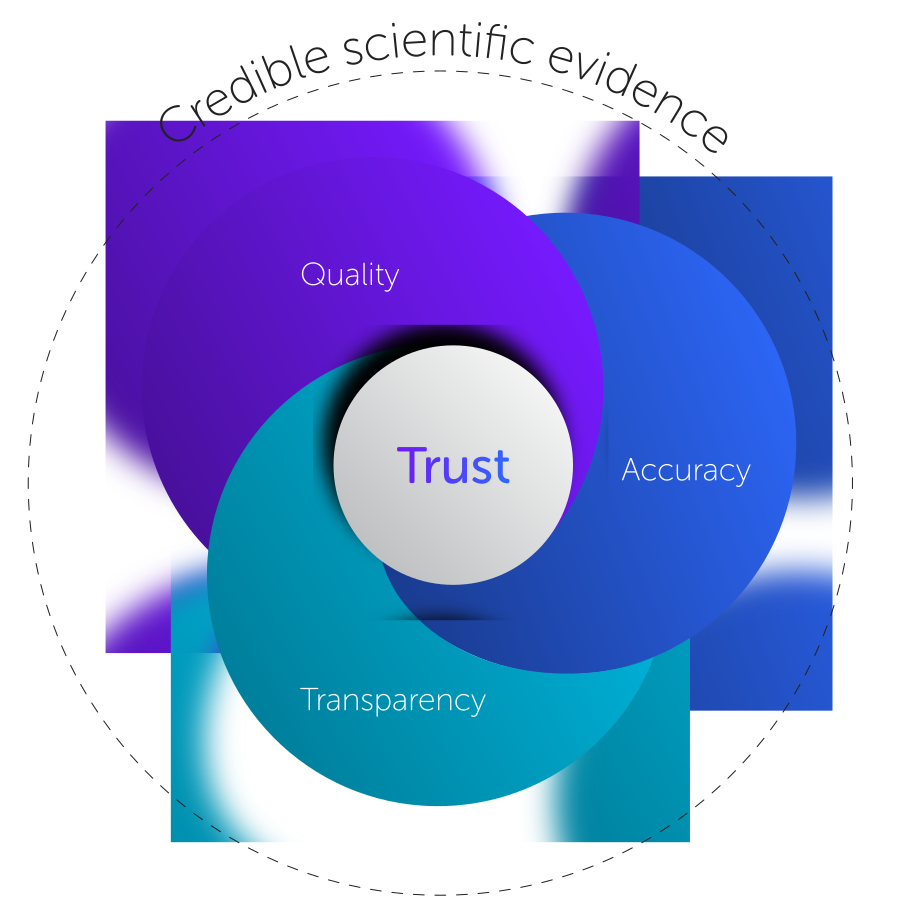
Above all else, life sciences professionals return to one set of consistent values: quality, accuracy, credibility, and transparency.
In an era when AI can generate information at scale, search algorithms determine what gets found, and scientific evidence reaches broader and more diverse audiences than ever before, trust becomes more important, not less.
The discussion around AI ultimately comes back to trust. Technology should strengthen the integrity, traceability, and credibility of scientific content. Clinicians, researchers, regulators, payers, health technology assessment (HTA) bodies, and patients depend on that integrity to make decisions that affect care, funding, and outcomes. Speed without accuracy and transparency is not progress.
Human expertise is irreplaceable
Even as AI adoption accelerates, medical, value and access, and commercial professionals are clear about what technology cannot replace: scientific judgment, contextual interpretation of data, and ethical accountability. These are central to how evidence is understood and applied.
AI can improve efficiency and scale, but it cannot replicate the expertise required to interpret complex data or shape credible scientific and value narratives. The future model is human-led and technology-enabled, with success defined by how effectively organizations combine expertise, data, and technology to create impact.
Publications must connect to a broader evidence strategy
Scientific publications are a core part of the evidence strategy. Their value lies in how effectively they bridge the gap between clinical efficacy and real-world value to support multi-stakeholder and healthcare decision-making.
The question has shifted from “How do we publish well?” to “How does published evidence create value by informing the decisions that matter most to stakeholders?”
Those questions differ by stakeholder. For payers, the focus may be comparative value, economic evidence, and reimbursement decisions. For prescribers, it may mean access to evidence that supports treatment selection and patient care decisions.
For patients and caregivers, particularly in rare diseases, it may mean translating complex scientific information into evidence that helps them ask better questions, understand treatment options, and navigate care with greater confidence.
Publication is now the beginning of the evidence journey, not the end.
Real-world evidence is reshaping what gets published and how it is used
RWE and health economic data have become central considerations in publication planning. As global payers, HTA bodies, regulators, and clinicians demand evidence that reflects how therapies perform in actual clinical settings rather than in controlled trials, RWE, burden of illness, cost-utility, and HEOR data are moving closer to the center of publication strategy.
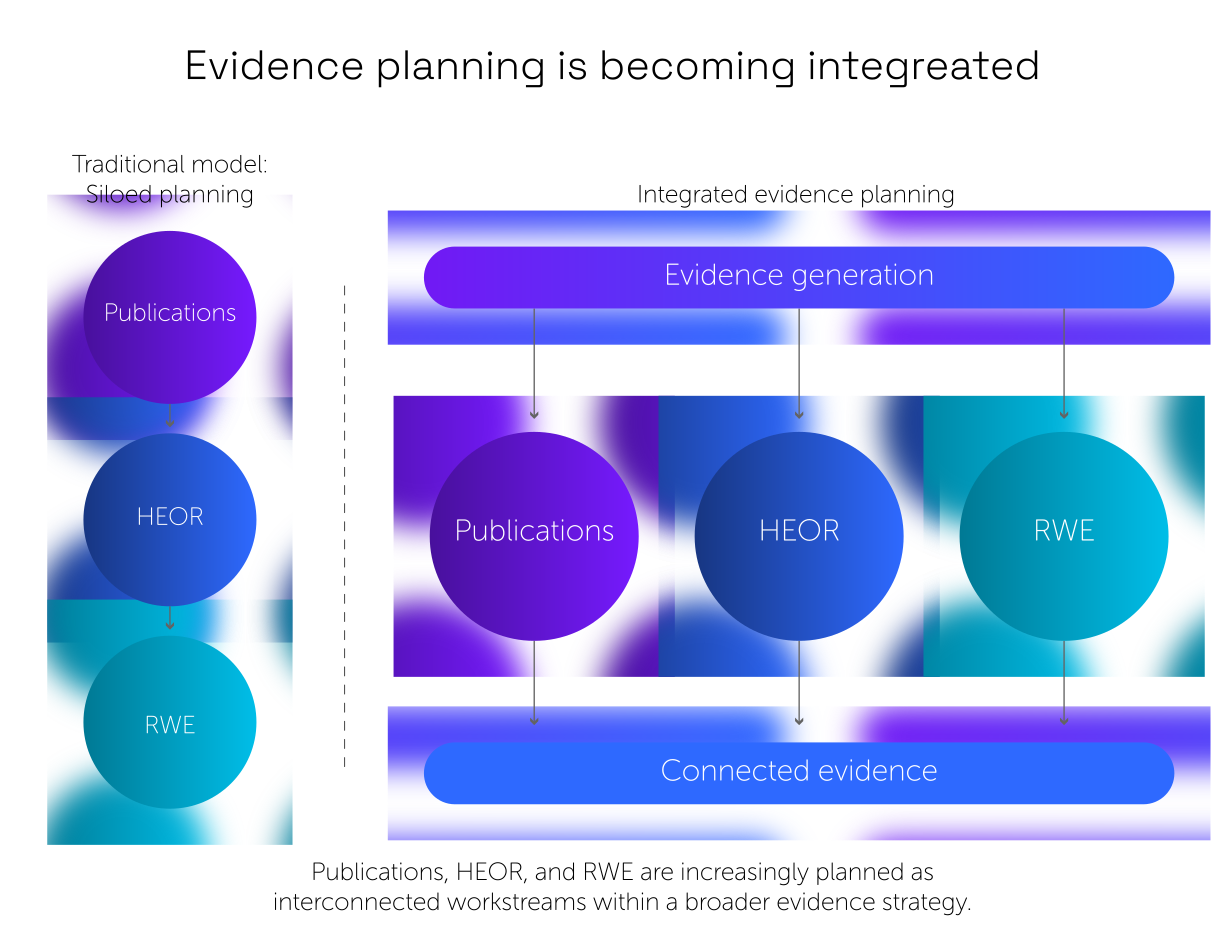
This has practical implications. Publication teams are increasingly working alongside HEOR functions, shaping robust data collection and dissemination strategies encompassing burden of disease through to RWE. For therapies entering established markets, real-world insights into cost-effectiveness and long-term outcomes are often the most relevant evidence for informing clinical and formulary decision-making.
The goal is not to bolt RWE and HEOR onto publication plans late in the process. It is to integrate them from the outset into a connected clinical and economic value story.
Information overload and discoverability are growing barriers
The volume of clinical data generated is growing significantly year on year. Important scientific information can be difficult to find, interpret, and connect to decision-making. There is a growing tension between that volume and the demand for transparency, increasingly leading to requirements to share all available data in extensive manuscript supplements. If not navigated expertly, the scientific story risks being buried under the weight of the evidence designed to support it.
The way evidence is discovered is changing. As AI-powered search and large language models (LLMs) become a primary route to information discovery, generative engine optimization (GEO) is emerging as a critical consideration. Content that is inaccessible, lacks clarity or structure, or is published in the wrong place may be overlooked, regardless of its scientific merit. For access teams, if an economic model or a crucial quality-of-life subanalysis is buried in unindexed supplemental data, AI search tools used by formulary committees will miss it entirely.
As evidence reaches broader audiences, accessibility becomes a strategic requirement rather than a communications add-on. Plain language summaries and structured formats now serve two purposes: improving human understanding and increasing discoverability in AI-driven search.
Access depends on availability as much as visibility. While open access is not universally mandated, it has become the prevailing expectation among global funders and policymakers. Requirements for immediate or near-immediate access to publicly funded research are reshaping journal selection, licensing models, and long-term budget planning.
Beyond compliance requirements, open access is an equity issue. When important evidence remains behind paywalls, access favors institutions, geographies, and stakeholders with the resources to pay. For patients, caregivers, community clinicians, advocacy groups, and researchers in lower-resource settings, open access can determine whether evidence is available at all.
The evidence ecosystem transcends journal articles
Journal publications are only one component of a modern, multi-channel evidence ecosystem. Congress outputs, including posters, oral presentations, symposia, and late-breaking data sessions, have long been important channels for disseminating emerging data and engaging directly with clinical specialists and key opinion leaders. What is changing is not their importance, but how they connect to publication pipelines, downstream content strategies, and the broader evidence narrative, extending the value of congress data beyond the event floor.
The future evidence ecosystem may be defined less by where evidence is first shared and more by how effectively it can be discovered, connected, reused, and applied to support stakeholder decision-making.
Preprints have also changed the pace of scientific communication. Their use accelerated during the COVID-19 pandemic, and they now represent a sustained shift toward faster, more open dissemination of research. Publishing choices are also becoming discoverability choices. As AI-powered search and LLMs play a greater role in how scientific information is found and synthesized, open-access content may be more readily discoverable than evidence behind paywalls.
Preprints can shape scientific, clinical, and policy discourse ahead of formal peer review, but they also introduce risk. Unreviewed findings may evolve, be challenged, or be misinterpreted if poorly contextualized. At the same time, the proliferation of predatory journals and low-quality publishing outlets has made it increasingly important for audiences to evaluate not only the accessibility of information, but also its origin, credibility, and scientific rigor.
Taken together, these shifts make one thing clear: treating journal articles as the sole output no longer reflects how evidence is generated, shared, and used.
Measurement must go beyond publication volume
Traditional publication success has focused heavily on operational milestones, delivery timelines, journal acceptance rates, citations, and compliance checkpoints. While these execution metrics remain essential baseline indicators, they do not reflect true scientific or clinical impact.
Success should be defined by the impact published evidence has on decision-making and outcomes. Measuring that impact requires more than publication metrics alone, combining traditional indicators with evidence of how scientific information is understood, applied, and used by stakeholders.
Beyond article-level metrics, leading organizations are expanding measurement to encompass broader indicators of scientific influence, including:
- Tools such as Scite, which classifies citations as supporting, mentioning, or contrasting with the original publication, alongside altmetric indicators that track early digital attention across social, news, and policy channels
- Qualitative insights from medical affairs field engagement and stakeholder dialogue, providing context on how evidence is interpreted and applied in practice
- Discoverability within AI-driven search and knowledge platforms, which is shaping how scientific visibility and accessibility are understood
This shift reflects a broader evolution recognized at The International Society for Medical Publication Professionals (ISMPP) conference and wider industry discussions: moving from output-based metrics to outcomes-based impact measurement.
Global complexity requires local fluency
Scientific publishing has always been an international endeavor, but the regulatory and communications landscape has never been more fragmented. Publication standards, journal preferences, language requirements, and the expectations of HTA bodies vary significantly across markets.
Regulatory expectations, HTA frameworks, language requirements, endpoint preferences, and health economic models vary significantly across markets. A publication strategy and plan designed for one region will not automatically serve a global evidence strategy.
Organizations operating across multiple geographies need programs that are both globally coordinated and locally adaptive. This requires maintaining consistent scientific integrity and core messaging, while tailoring evidence generation, dissemination, and positioning to meet local regulatory requirements, HTA expectations, linguistic norms, and stakeholder needs.
This capability remains underdeveloped in many organizations, but it is becoming increasingly important for organizations operating across global markets.
What this means for life sciences leaders
The implications are clear. Scientific publications must operate as a connected evidence system rather than a set of standalone outputs. A single study may now flow through a lifecycle of linked publications, each building on a shared evidence base, while the same data must simultaneously serve regulators, payers, clinicians, and field medical teams, each requiring different levels of interpretation and context.
Published content is no longer an endpoint. It is a reusable source of evidence that supports medical affairs materials, congress assets, and AI-enabled tools that surface and synthesize evidence across channels. Understanding how evidence is reused, adapted, and applied across these touchpoints is becoming an increasingly important way to assess the value generated by publication activities. This shift also changes how scientific and publication functions operate.
By reducing duplication, reusing approved content, and supporting more efficient global adaptation, connected evidence models help teams scale scientific communications more sustainably while extending the reach and impact of scientific evidence without increasing operational burden.
These themes are not predictions. They reflect changes already underway across the industry, and the organizations adapting now will be better prepared for the future.
The next question is practical: how should organizations respond?

So what? The practical takeaway
Start by asking whether your publication program is designed to deliver evidence or impact. If your metrics still stop at acceptance and timelines, you may be measuring the wrong things. Consider how evidence is being discovered, reused, discussed, and applied across stakeholder groups, and whether it is informing decisions, addressing evidence gaps, or creating measurable value beyond publication itself.
If your planning does not yet include integrated evidence generation, RWE, HEOR, patient advocacy, and plain-language outputs as core elements, that is where to start.
Is your evidence ecosystem keeping pace with how science is now used?
With more than 20 years of experience in scientific evidence generation, publications management, and medical communications, and an active role in shaping industry best practice through bodies such as ISMPP, we bring a depth of perspective that goes beyond individual deliverables, tools, or services.
If you want to explore what a more connected, measurable approach to publications could look like for your organization, we’d welcome the conversation.
Contact us at: envisionpharmagroup.com/contact-us.